



 Share this page by mail
 Graphite Felts 2,000 °C
Graphite Felts, heat-resistant up to 2.000 °C
Graphite is a mineral of elemental carbon (C) with a hexagonal crystalline structure. This flexible and soft material stands out with its black or grey-black colour. Carbon and graphite products are appreciated for their physical and chemical properties: heat resistance, chemical neutrality, electrical and thermal conductivity, low coefficient of friction, low absorption coefficient of X-rays and electrons as well as low coefficient of thermal expansion. Moreover, these products can be used in different fields: they can be found in alkaline batteries and pencils but also in the automobile, metallurgy and high technologies industries.
Graphite felts provied by Final Advanced Materials offer excellent thermal resistivity. They can indeed withstand operating temperatures up to 2,000 °C in inert atmosphere. These products are mainly used in the industry for the thermal insulation of vacuum furnaces or the manufacture of different furnaces.
Graphite felts are available flexible and rigid with a thickess ranging from 6 to 50 mm. A purified version of these graphite felts is possible, with a proportion of ash lower than 20 ppm.
For more information regarding the availability, refer to the technical data sheet.
Benefits of High-Temperature Graphite Felts
- Low thermal conductivity
- Low specific heat: allowing for rapid heating and cooling of furnaces.
- High thermal stability: in oxidizing atmospheres up to 350 °C, in protective or vacuum atmospheres up to approximately 3,000 °C for graphite and 1,000 °C for carbon.
- Ease of processing: can be cut with scissors or blades. Adapted to small flexural radii.
- Good surface properties: unaffected by all molten metals.
- High purity: low sulphury and ash content
- No electrostatic charging
- High resistivity: coupling in an inductive field only occurs above 12 kHz.
Main Applications of Graphite Felts
- Thermal insulation of vacuum furnaces and inert gas
- Degassing furnace
- Brazing furnace
- Annealing furnace
- Sintering furnace for metals
- Induction furnace
- Filter for hot or corrosive liquids and gas and molten metal
- Support for welding
General Data on High-Temperature Graphite Felts

Technical Data on High-Temperature Graphite Felts
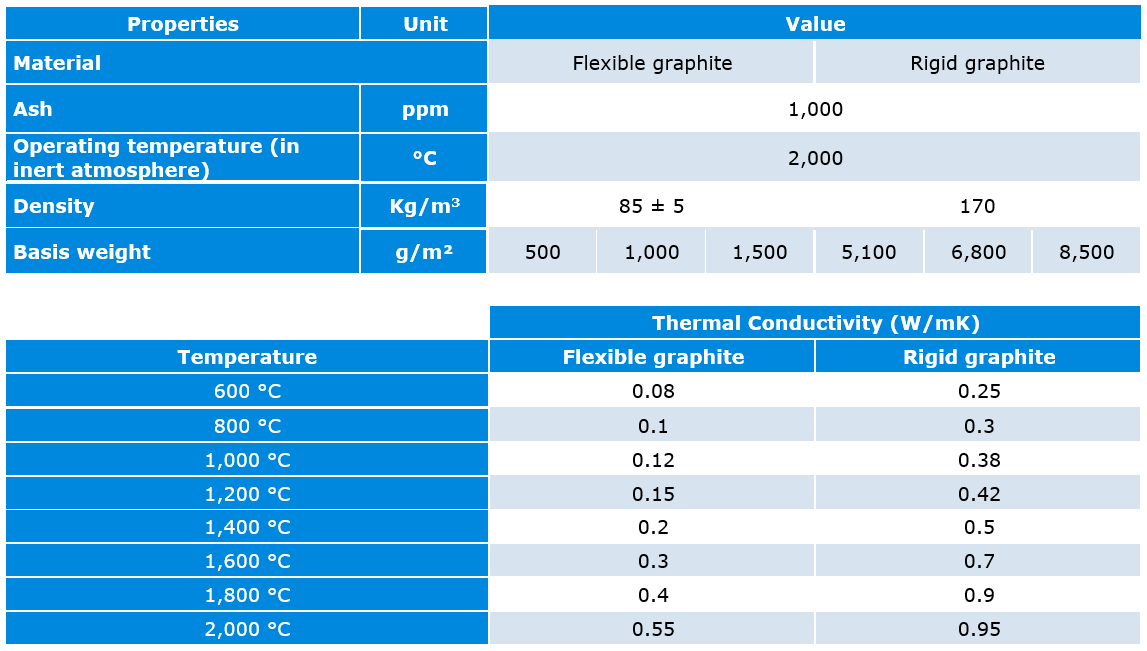
Physical variables included in this documentation are provided by way of indication only and do not, under any circumstances, constitute a contractual undertaking. Please contact our technical service if you require any additional information.
FAQs that can help you in this category
Graphite can withstand different temperatures depending on the atmosphere in which it is used. Its working environment directly affects its thermal performances.
In a vacuum or an inert atmosphere, graphite can withstand extremely high temperatures, even above 2,000°C. If oxygen is not present, the material retains excellent thermal and structural stability.
In air or an oxidising atmosphere, however, the maximum working temperature is lower. At around 400 to 500°C and above; graphite starts to oxidise gradually on contact with oxygen, leading to a degradation of its properties and loss of material.
Choosing the right graphite grade and considering the atmospheric conditions in which the graphite will be used is absolutely necessary to obtain the performance and lifetime needed for a given application.
The Final Advanced Materials team is at your disposal to help you choose the most suitable graphite solution based on your thermal and environmental constraints.
Due to its layered crystalline structure, graphite has excellent electrical and thermal conductivity properties.
This organisation facilitates the movement of electrons and the propagation of heat within the material.
However, graphite also has anisotropic properties: its conductivity varies depending on the direction of the crystalline layers. Conductivity is thus higher in the direction parallel to the layers than in the direction perpendicular to them.
Parameters such as the graphite's purity and density also influence its electrical and thermal characteristics. All these characteristics therefore determine the level of conductivity of the material.
Despite these variations graphite remains an excellent thermal and electrical conductor, which is particularly suited to many demanding industrial environments.
The Final Advanced Materials team is at your disposal to help you choose the most suitable graphite for your technical requirements.
Graphite is an excellent solution for aggressive chemical environments.
Due to its great chemical stability, it resists most acids and bases, including at high concentrations.
Unlike metals, graphite does not rust and does not dissolve in most corrosive environments, making it a material which is particularly suitable for demanding applications.
However, there are certain limitations which be taken into account. In the presence of oxygen and high temperature, graphite is subject to oxidisation which can impair its properties. In addition, in fluorinated environments, in particular in the presence of hydrofluoric acid, a direct chemical reaction with carbon can occur.
The choice of graphite and working conditions therefore depends on the application's chemical and thermal environment.
The Final Advanced Materials team is at your disposal to help you choose the best graphite for your technical requirements.
A graphite-loaded cement is a particularly suitable solution for repairing graphite parts.
Its chemical compatibility with the material, along with its thermal expansion and electrical conductivity, which are similar to those of graphite, make it a preferred solution for this type of application.
Ceramic-loaded cements are particularly recommended for localised repairs which do not require high a mechanical strength.
The Final Advanced Materials team is at your disposal to help you choose the best solution for your technical constraints.
Graphite naturally possesses lubricating properties which is one of its most widely acknowledged characteristics.
Due to its layered structure, where the different layers easily slide over one another, it is an excellent solid lubricant.
However, its performance can vary depending on the working environment. In an inert atmosphere or in a vacuum, its effectiveness diminishes due to the scarcity of gas and moisture, elements which make it easier for the graphite layers to slide over one another.
However, in an oxidising, high-temperature atmosphere the main challenge is its natural oxidisation, which can impair the graphite’s properties.
The choice of graphite therefore depends directly on the working conditions and on the constraints specific to your application.
The Final Advanced Materials team is at your disposal to help you select the graphite solution which is most effective and best suited to your needs.