


 Share this page by mail
 High Temperature Silicate Fibre Sleeves 1,100 °C
Silicate Fibre Sleeves, up to 1,100 °C
Silicate is a mineral made of silicon dioxide (SiO2) and other metallic oxides, such as magnesium, calcium, aluminium, etc. With their diameter of 9 μm, silicate fibres pose no health risk when handling.
Silicate fibre is inorganic. In addition to containing no toxic substances, its great thermal and mechanical properties make it an interesting alternative to ceramic fibre. Its resistance to high temperatures outperforms that of other materials, such as glass or basalt fibre.
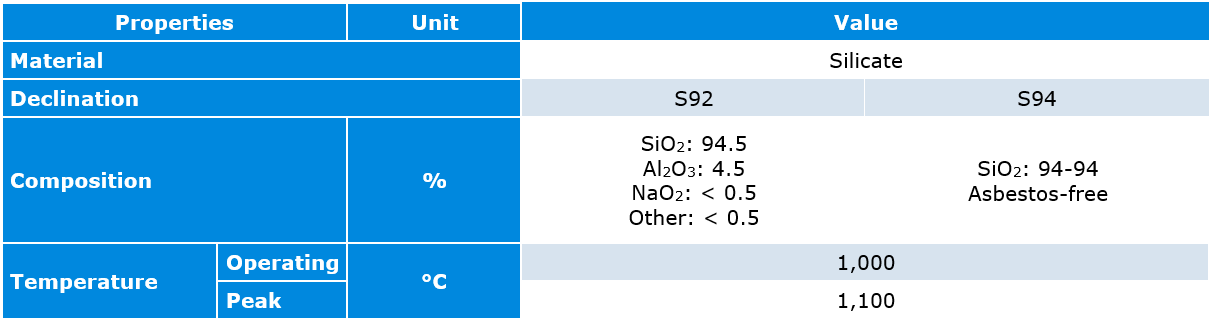
Depending on their level of silicon dioxide, silicate fibre textiles offer different thermal, physical and mechanical properties. The silicate fibre sleeves proposed by Final Advanced Materials can therefore withstand peak temperatures up to 1,100 °C and operating temperatures up to 1,000 °C. They are used in the industry for the insulation of cables and piping, for heat protections but are also as an alternative to asbestos products.
Final Advanced Materials offers silicate fibre sleeves with inner diameters ranging from 1 to 100 mm. To adapt to every application, different declinations of the silicate fibre are available for silicate fibre sleeves.
For more information regarding the availability, refer to the technical data sheet.
Applications of Silicate Fibre Sleeves
- Insulation of cables
- Insulation of pipes
- Electrical insulation
- Heat protection
- Alternative to asbestos products
General Information: Silicate Fibre

Technical Information: Silicate Fibre
Physical variables included in this documentation are provided by way of indication only and do not, under any circumstances, constitute a contractual undertaking. Please contact our technical service if you require any additional information.
FAQs that can help you in this category
Sleeves are tubes, usually flexible, designed to protect cables or electrical components from electricity, heat, and mechanical forces or impacts. Final Advanced Materials offers sleeves capable of withstanding temperatures up to 1,300°C in continuous service. For protection against radiant heat, Final Advanced Materials manufactures custom laminated sleeves using thin aluminium foils. This construction reflects up to 95% of radiation exchanges, thereby protecting cables from exposure to excessively high temperatures.
Few materials are suitable for exposure to contact temperatures over 1,200°C in continuous service, without radiation. Silica fibres, for example, are not stable during prolonged exposure. If you are seeking electrical insulation without the risk of deformation at such temperatures, ceramic fibre is the only viable solution. Other materials may also be suitable, depending on the duration and frequency of exposure, such as materials made of coated or uncoated glass fibres, basalt fibres, or silica fibres. However, these parts will need to be replaced regularly, and the replacement frequency will depend on the usage.
The primary downside of textile products is their low resistance to abrasion. To counteract this downside, Final Advanced Materials offers numerous treatments (silicone, PTFE) which improve this resistance. It should however be noted that these treatments can modify the sleeve’s behaviour when exposed to temperature.
For optimal thermal insulation, whether for operator protection or for reduced heat loss, it is important to select the correct insulating material and thickness. Final Advanced Materials has the necessary teams and skills to simulate these thermal exchanges and can determine not only the appropriate material but also the required thickness.