 Share this page by mail
 Light Lock - Cyanoacrylate adhesive Bostik Born2Bond™
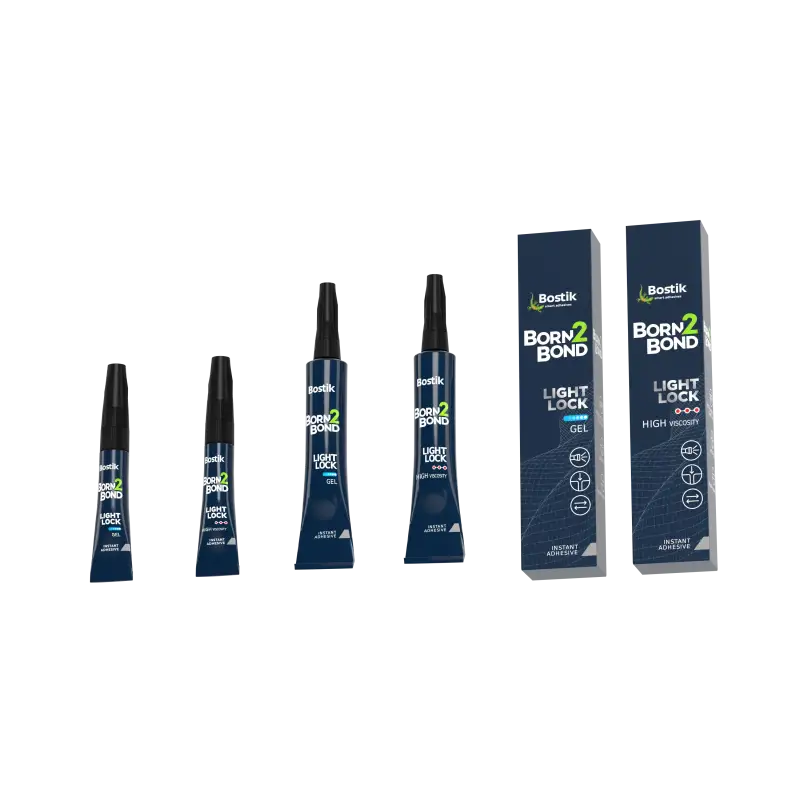
Born2Bond™ Light Lock HV and Gel are patented, low-odor, low-blooming, dual-curing (contact and light curing) cyanoacrylate adhesives.
They are designed for bonding applications that require fast fixturing, coating or surface cure.
The UV and visible-light cure sensitivity allow rapid bonding through transparent parts and quick curing of light-exposed bulk or surface-coated areas. Further, the product’s instant bonding capability ensures cure between opaque substrates (contact cure).
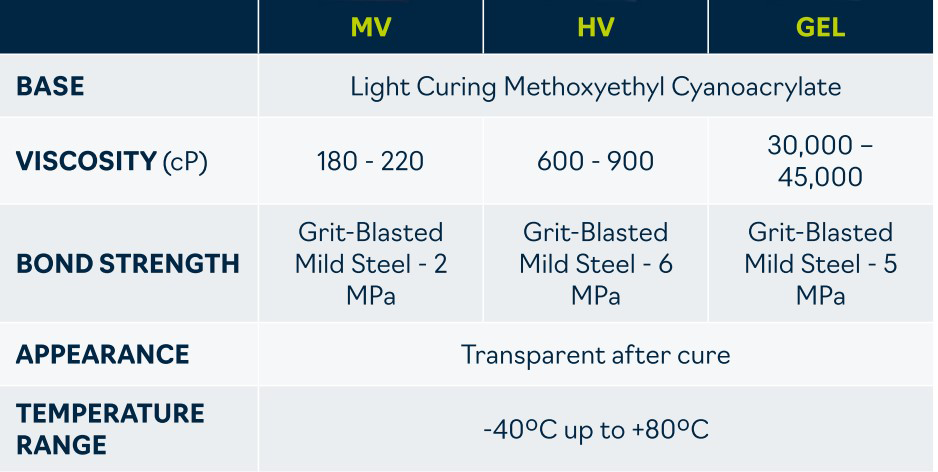
Details of our range with the references Light Lock HV, MV and Gel:
Features:
- Dual cure formulation: instant and photo-cure
- Fixture time in 60 seconds without light exposure, and 5 seconds with light curing
- Can be cured with visible and UV-LED light
- Long open time without activation
- Dry to touch, tack free surface cure

- Bonds, fills, reconstructs and coats
- Low odor, low blooming
- Available in a range of viscosities: LV (Low Viscosity), MV (Medium Viscosity), HV (High Viscosity) and GEL
- Cure-on-demand of excess material released from bondlines
The choice depends mainly on the temperature and the mechanical stresses. Final Advanced Materials' high-temperature epoxy resins are generally limited to between 150 and 350°C, with satisfactory mechanical resistance (typical sheer-stress 10–30 MPa) and a degree of elasticity. However, the ceramic cements produced by Final Advanced Materials can be used up to 2,200°C, depending on the grade (alumina, zirconia, silicate, silica). They have excellent temperature resistance, but remain fragile (brittle behaviour, no elasticity). In the case of assemblies subject to differential expansion or vibration, epoxy is by far the preferred solution, if permitted by the maximum temperature of the application. However, in the case of extreme environments (kiln, vacuum, reducing atmosphere) which exceed 350°C, ceramic cement must be chosen.
The ceramic cements distributed by Final Advanced Materials have maximum working temperatures ranging between 650°C and 2,200°C. For example, alumina-based formulations often reach 1,650–1,760°C in an oxidising atmosphere. However, silicate systems are limited to around 1,000–1,200°C. The real maximum working temperature depends greatly on the environment (air, vacuum, inert gas), the time of exposure to this temperature and the thermal cycle (gradient, thermal shock). Specifically: the metal-loaded ceramic adhesives produced by Final Advanced Materials resist only up to the maximum temperature of the filler (650°C, for example, in the case of aluminium powder).
Ceramic/metal assemblies require often very different coefficients of thermal expansion (CTE) to be controlled. Final Advanced Materials recommends alumina-, silica- or zirconia-based ceramic cements for temperatures >350°C, which can bond to all types of ceramics and, generally, metals. For intermediate applications (≤350°C), an epoxy resin loaded with alumina powder enables thermal stresses to be absorbed and will be very compatible with different expansion coefficients. The thickness of the bond line must be between 100 and 300 µm to limit stress. Surface pre-treatment (sanding, degreasing, etc.) greatly improves adherence and is absolutely necessary if the CETs are very different.
The Cotronics adhesives distributed by Final Advanced Materials have variable cycles.
In the case of a cement, initial drying at ambient temperature takes between 2 to 24 h, depending on the viscosity and thickness. A thermal aftertreatment can be performed to allow them to attain their optimum properties after firing. Excessively rapid drying can lead to cracking or porosity in the cement.
Final Advanced Materials' epoxy adhesives which resist up to 260°C must be cured at ambient temperature. Epoxy adhesives which resist up to over 300°C require heat curing.