



 Share this page by mail
 High Temperature Biosoluble Fibre Fabrics 1,150 °C
Biosoluble Fibre Fabrics, up to 1,150 °C
Biosoluble fibres are a non-carcinogenic insulation material. Thanks to these fibres, the health risks associated with exposure to asbestos, ceramic fibres and mineral fibres can be eliminated as biosoluble fibres represent a safe and reliable alternative. Their composition enables their dissolution by physiological fluids, allowing pulmonary elimination. Our biosoluble fibre products are free of chemical binder. They however maintain excellent thermal insulation and fire protection properties.
The biosoluble fibre fabrics are reinforced with E-glass fibre or heat-resistant steel. They therefore offer better mechanical properties. Depending on the material used, these products can withstand operating temperatures up to 1,050 °C and peak temperatures up to 1,150 °C. During their manufacture, they are thermally treated to reduce airborne fibres and dust. Thanks to their insulation properties, these fabrics are used in the industry for the insulation of pipes, exhausts, furnaces or electrical insulation but also for metal working.
The biosoluble fibre fabrics proposed by Final Advanced Materials are available with a thickness ranging from 2 to 3 mm.
For more information regarding the availability, refer to the technical data sheet.
Applications of Biosoluble Fibre Fabrics
- Insulation for pipes and exhausts
- Electrical insulation
- Metal working
- Insulation of furnaces
General Data: Biosoluble Fibres

Technical Data: High-Temperature Biosoluble Fibre Fabrics
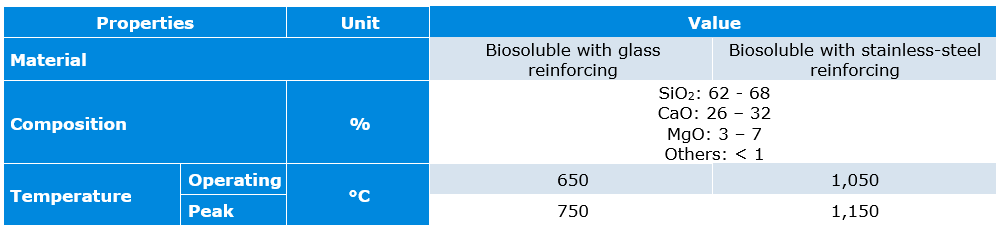
Physical variables included in this documentation are provided by way of indication only and do not, under any circumstances, constitute a contractual undertaking. Please contact our technical service if you require any additional information.
FAQs that can help you in this category
Final Advanced Materials offers a very wide selection of fabrics which can withstand temperatures ranging between -72°C and +2,000°C. For applications reaching temperatures as high as 550°C, fibreglass-based fabrics are the most versatile. They combine high mechanical and chemical resistances and are also effective electrical and thermal insulators. For applications with a continuous exposure to temperatures over 500°C, fabrics made from basalt fibre (800°C), silicate fibre (1,000°C) or ceramic fibre (1,300°C) are recommended. The choice of fabric depends on the desired application. Whether for insulation or protection, the service conditions are a determining factor for the choice of fabric.
The Zetex and ZetexPlus fabrics produced by Final Advanced Materials are both high-temperature fibreglass fabrics, used for thermal protection or insulation applications. Zetex fabrics are suitable for standard uses, with a resistance to temperatures of 540°C in continuous service and up to 700°C short-term. ZetexPlus fabrics are given a vermiculite-based treatment which improves their resistance to abrasion and mechanical stresses, while enabling them to withstand high temperatures, 815°C in continuous service, and up to 1,095°C short-term. The choice between these two materials therefore depends primarily on the working conditions.
Final Advanced Materials offers a wide range of products for extreme applications. Ceramic fibre-based and silicate fibre-based textiles are mainly used to manufacture parts in the aeronautical and aerospace sector.
They have an excellent thermal shock resistance, and can withstand exposure to temperatures of over 1,200°C short-term. These products are available in a wide range of forms, such as fabrics, braids, sleeves, tapes and non-wovens.
The ceramic fibre fabrics and the silica fibre fabrics offered by Final Advanced Materials are designed for the most extreme applications. When made into a fabric, ceramic fibres have a better stability at high temperature than silica-based fibres. Silica fibres have inferior mechanical properties and have a high shrinkage rate of 7 to 12%. It is however possible to thermally treat silica fabrics to reduce this shrinkage to only 1 to 4%.