



 Share this page by mail
 ZYF Zirconia Fibre Felt 2,100 °C
ZYF Zirconia Fibre Felts, up to 2,100 °C
At Final Advanced Materials, the zirconia fibre felts are made of 100 % zirconia fibre with a diameter ranging from 4 to 6 µm, stabilised with 10 % yttrium oxide. The zirconia fibre has an extremely low thermal conductivity. The products are entirely composed of inorganic fibres and contain no binder.
Designed for highly corrosive environments and high-temperature applications, ZYF needled felts don’t react to alkaline vapour, salts or hot and concentrated solutions. Moreover, they offer high resistance to extreme temperatures. They can withstand peak temperatures up to 2,100 °C and operating temperatures up to 2,000 °C. They don’t wet in contact with most molten metals. They also remain efficient in highly oxidising and reducing atmospheres.
These lightweight and very porous felts are effective thermal insulators for loading supports, for crystal growth furnaces or for separators in electrolytic cells. They can be easily cut for custom applications.
For more information regarding the availability, refer to the technical data sheet.
Main Applications of Zirconium Oxide Fibre Felts
- Thermal insulation of crystal growth furnaces
- Thermal insulation of separators for electrolytic cells
- Thermal insulation of loading supports
- Custom applications
General Data on Zirconia Fibres

Technical Data on Zirconia Fibre Felts
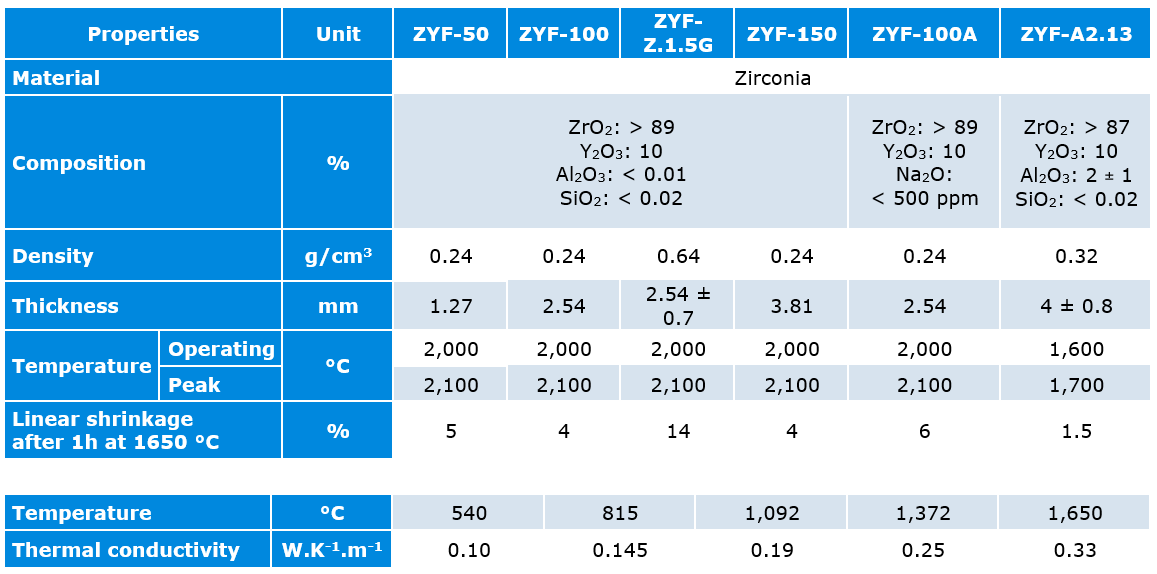
Physical variables included in this documentation are provided by way of indication only and do not, under any circumstances, constitute a contractual undertaking. Please contact our technical service if you require any additional information.
FAQs that can help you in this category
Felts made from carbon/graphite fibre are excellent at withstanding high temperatures, and are used up to 3,000°C. These felts are stable up to 2,000°C, but only in an inert, oxygen-free environment. Otherwise, they oxidise above 300°C. Unlike carbon/graphite felts, zirconia felts are resistant to temperatures up to 2,000°C, even in the presence of oxygen in the environment.
Final Advanced Materials' biosoluble fibre felts are a safe alternative to replace asbestos-based insulation or other refractory fibres. These fibres have low biopersistence, meaning the body can eliminate any inhaled fibre rapidly and naturally. These felts have a low thermal conductivity and a temperature resistance of up to 1,400°C, and are used primarily as oven coatings, but also as a customisable local thermal insulation.
The only felts capable of withstanding a continuous exposure to temperatures exceeding 1,500°C are ceramic (Al2O3), zirconia (ZrO2) or graphite fibre-based felts. Each felt has specific constraints: graphite felts can only be used in an inert atmosphere or in a vacuum, while zirconia felts have poor mechanical properties, and ceramic fibre felts can only resist temperatures up to 1,650°C.
The other felt families (glass, silica, biosoluble, RCF, basalt, etc.) cannot withstand a continuous exposure to more than 1,260°C.
The material has a thermal conductivity of 0.06 W/m·K at 200°C, and 0.30 W/m·K at 1,000°C. It is substantially lower than that of conventional refractory materials (often between 1 and 2 W/m·K at these temperatures). The felts offered by Final Advanced Materials are available in several densities, ranging from 64 to 160 kg/m3. The higher the density, the lower the conductivity which can go as low as 0.20 W/m·K at 1,000°C.