



 Share this page by mail
 HT Biosoluble Fibre Twisted Ropes 1,150 °C
Biosoluble Twisted Ropes, up to 1,150 °C
Biosoluble fibres are guaranteed asbestos and ceramic fibre-free. In order to eliminate the health risks associated with exposure to ceramic fibres or rock fibres for insulation, their chemical composition has been adapted. These fibres dissolve in bodily fluids such as those found in the pulmonary alveoli. They are less biopersistent, meaning they are eliminated more quickly by the body while maintaining their excellent thermal insulation and fire protection qualities.
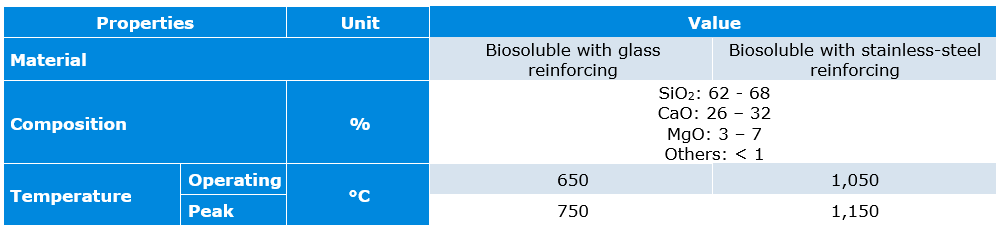
Biosoluble fibre twisted ropes offer good thermal resistivity. They can resist operating temperatures up to 1,050 °C and peak temperatures up to 1,150 °C. These products are therefore used in the industry for the insulation of industrial furnaces, boilers, cables, etc.
The biosoluble fibre twisted ropes provided by Final Advanced Materials are available with sections ranging from 3 to 50 mm. They can be reinfoced with E-glass fibre or heat-resistant steel.
- Glass fibre reinforcement is more cost-effective, and provides the benefit of not being electrically conductive;
- Heat-resistant steel reinforcement increases the strength of the high-temperature twisted ropes, and improves its physical properties, whilst preserving its initial flexibility.
For more information regarding the availability, refer to the technical data sheet.
Applications of Biosoluble Fibre Twisted Ropes
- Insulation of industrial furnaces
- Insulation of boilers
- Insulation of pipes
- Insulation gasket
- Insulation of cables
General Information: Biosoluble Fibre

Technical Information: Biosoluble Fibre
Physical variables included in this documentation are provided by way of indication only and do not, under any circumstances, constitute a contractual undertaking. Please contact our technical service if you require any additional information.
FAQs that can help you in this category
The main difference between these two solutions is the working temperature. Zetex is stable from 500 to 700°C, while silicate fibres can withstand temperatures up to 1,000–1,200°C.
Biosoluble fibre twisted ropes and braided ropes are soft, flexible, and compressible. They retain some of their elasticity after compression, but it depends on the pressure exerted. The recovery rate also depends on the type of reinforcement used. Final Advanced Materials offers biosoluble fibre twisted ropes and braided ropes with fibreglass or stainless-steel reinforcements for ovens operating up to 1,200°C.
The rope’s diameter depends on the size of the groove. As a general rule, the rope should be 10% to 20% wider than the groove to ensure effective compression. These values depend on the nature of the components.