 Share this page by mail
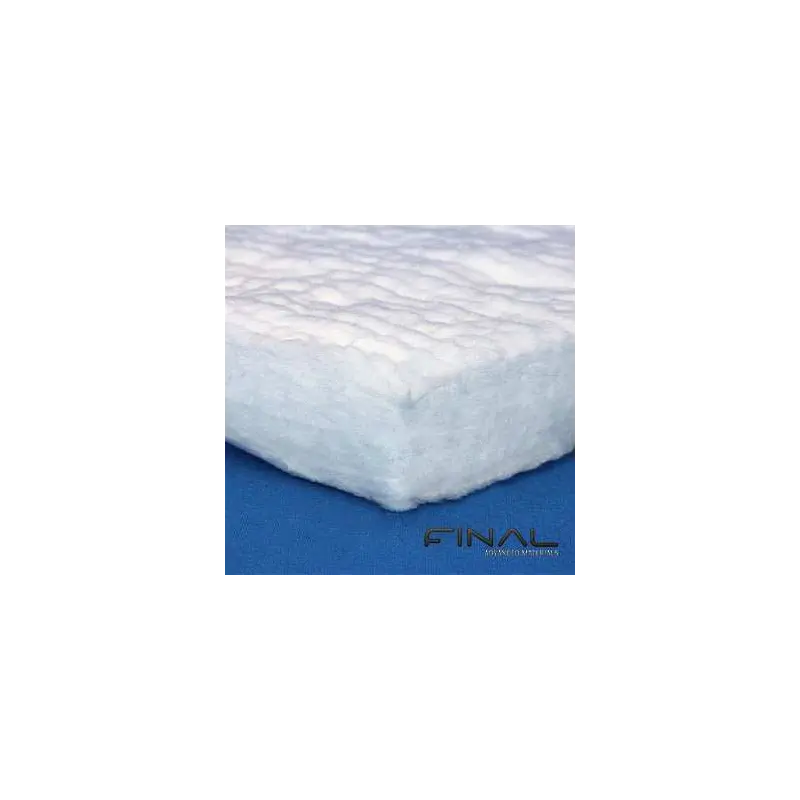
 Biosoluble Fibre Felt 96 kg/m³
Biosoluble Fibre Felt 96 kg/m³
Biosoluble fibre is an insulation material made from alkaline earth silicate wool.
Biosoluble fibres felt have an extremely uniform structure resistant to continous temperatures up to 1,260 °C.
Available in thicknesses from 6 to 50 mm and a density of 96 kg/m3.
On request it is possible to have a biosoluble fibre felt with an aluminium side or with a density of 128 kg/m3.

- Continuous temperature: 1,200 °C
- Without health risks
- Excellent thermal insulation high temperature
- Easy to cut and to shape
- Available in width of 610 mm
- Available in thickness of 6, 13, 25 and 50 mm

Felts made from carbon/graphite fibre are excellent at withstanding high temperatures, and are used up to 3,000°C. These felts are stable up to 2,000°C, but only in an inert, oxygen-free environment. Otherwise, they oxidise above 300°C. Unlike carbon/graphite felts, zirconia felts are resistant to temperatures up to 2,000°C, even in the presence of oxygen in the environment.
Final Advanced Materials' biosoluble fibre felts are a safe alternative to replace asbestos-based insulation or other refractory fibres. These fibres have low biopersistence, meaning the body can eliminate any inhaled fibre rapidly and naturally. These felts have a low thermal conductivity and a temperature resistance of up to 1,400°C, and are used primarily as oven coatings, but also as a customisable local thermal insulation.
The only felts capable of withstanding a continuous exposure to temperatures exceeding 1,500°C are ceramic (Al2O3), zirconia (ZrO2) or graphite fibre-based felts. Each felt has specific constraints: graphite felts can only be used in an inert atmosphere or in a vacuum, while zirconia felts have poor mechanical properties, and ceramic fibre felts can only resist temperatures up to 1,650°C.
The other felt families (glass, silica, biosoluble, RCF, basalt, etc.) cannot withstand a continuous exposure to more than 1,260°C.
The material has a thermal conductivity of 0.06 W/m·K at 200°C, and 0.30 W/m·K at 1,000°C. It is substantially lower than that of conventional refractory materials (often between 1 and 2 W/m·K at these temperatures). The felts offered by Final Advanced Materials are available in several densities, ranging from 64 to 160 kg/m3. The higher the density, the lower the conductivity which can go as low as 0.20 W/m·K at 1,000°C.