



 Share this page by mail
 High Temperature Biosoluble Fibre Tapes 1,150 °C
Biosoluble Fibre Tapes, up to 1,150 °C
Biosoluble fibres are guaranteed asbestos and ceramic fibre-free. To eliminate the health risks associated with exposure to ceramic fibres or rock fibres for insulation, their chemical composition has been adapted. These fibres dissolve in bodily fluids such as those found in the pulmonary alveoli. They are less biopersistent, meaning they are eliminated more quickly by the body while maintaining their excellent thermal insulation and fire protection properties.
Biosoluble fibre tapes offer great thermal resistivity. They are therefore used in the industry for the insulation of pipes, exhausts and furnaces. Thanks to their properties, they are also employed for electrical insulation and metal working.
The biosoluble fibre tapes provided by Final Advanced Materials are available in 2, 3 and 5 mm thicknesses with widths of 10 to 200 mm. A reinforcing with E-glass fibre or heat-resistant steel is also possible to obtain better mechanical properties. Depending on the reinforcing used, the tapes can resist operating temperatures up to 1,050 °C and peak temperatures up to 1,150 °C.
For more information regarding the availability, refer to the technical data sheet.
Applications of Biosoluble Fibre Tapes
- Insulation of pipes and exhausts
- Electrical insulation
- Metal working
- Insulation of furnaces
General Data: Biosoluble Fibre

Technical Data: Biosoluble Fibre
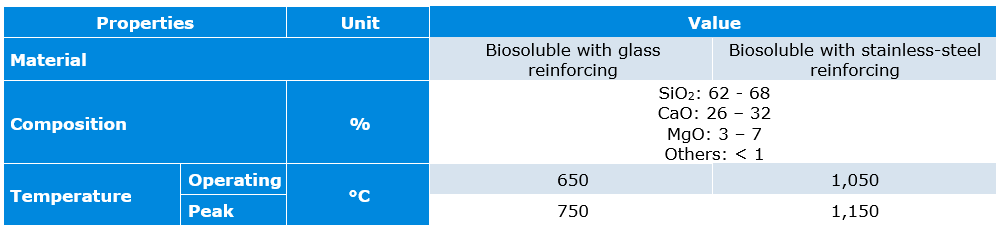
Physical variables included in this documentation are provided by way of indication only and do not, under any circumstances, constitute a contractual undertaking. Please contact our technical service if you require any additional information.
FAQs that can help you in this category
Whether for insulation or protection applications, high-temperature tapes are frequently used in the industry, on manifolds, tubes and exhausts. Final Advanced Materials produces fibreglass tapes with excellent insulating properties up to 550°C, and basalt fibre tapes which combine insulation and thermal stability up to 700°C and also have a natural bronze colour without treatment. These tapes can be coated with silicone to meet sealing needs.
Basalt fibres and ceramic fibres are inorganic fibres which are resistant to very high temperatures: 700°C and 1,100°C respectively. They are used in the industry or the aeronautics sector for insulation and protection applications, primarily thermal protection. Both these fibres have excellent temperature resistance and effective thermal and electrical insulation. The temperature they will be exposed to is the main factor determining the choice of tape. If it is lower than 700°C, we recommend a basalt fibre tape which is more cost-effective.
Like most inorganic fibres, high-temperature fibreglass tapes are sensitive to abrasion. Final Advanced Materials offers tapes with surface treatments to improve this resistance. Certain coatings, such as silicone, also make the material waterproof, while others, like vermiculite, increase short-term temperature resistance or reduce slag formation.