



 Share this page by mail
 Electrically conductive Epoxy resin
Overview of electrically conductive Epoxy
Cotronics® Duralco® conductive adhesives and potting compounds provide the conductivity required for many high temperature electronic and industrial applications. These ultra-temperature adhesives combine Cotronics®’ unique resins and hardeners with specialty conductive fillers to provide continuous service up to 340°C. They will bond to glass, ceramics, metals and plastics and offer excellent resistance to most chemicals and solvents.
Electrically conductive Epoxy Applications
- Solder replacement,
- Semi-conductor bonding,
- Shielding,
- Electronics,
- Circuit board repair…
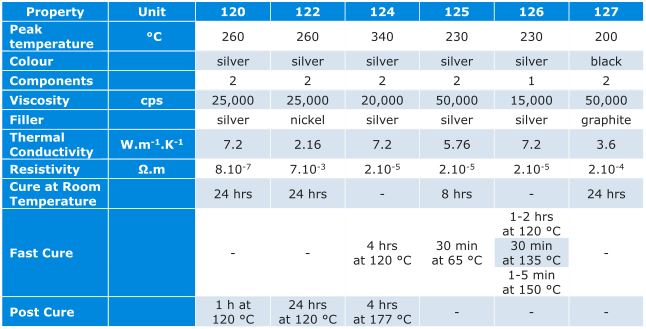
Electrically conductive Epoxy Technical data
260°C - Duralco® 120
Hi-conductive Silver based Epoxy
Duralco® 120 is a Silver filled Epoxy that cures at room temp. to form electrically conductive bond lines for use to 260°C. Contains over 70% Ultra Fine Active Silver to provide the ultimate in electrical conductivity. Resistance of 0.00008 Ω.cm have been reported in independent tests. Duralco® 120 is ideal for forming electrically conductive bonds, attaching heat sensitive components and as a solder replacement.
260°C - Duralco® 122
Low Cost Nickel based Epoxy
Duralco® 122 is a Nickel filled Adhesive and casting Epoxy, formulated to provide an economical alternative to silver filled, electrically conductive epoxies. Duralco® 122 is low in cost and highly conductive. It is ideal for use in applications where the upmost in electrical conductivity is not required. Can be used to 260°C.
340°C - Duralco® 124
Ultra-temperature Silver based Epoxy
Duralco® 124 is a two component, silver filled adhesive for High Power applications. Just mix and cure with mild heat. Can be used up to 340°C.
230°C - Duralco® 125
Flexible conductive Silver based Epoxy
Duralco® 125 is easy to use, "one to one", applicator kit. Just dispense, mix and apply this smooth creamy paste and cure at room temp. Bonds to most metals, ceramics, and plastics to form stress free, electrically conductive bonds.
230°C - Duralco® 126
One component, Silver based Epoxy
Duralco® 126 is a one component, highly conductive epoxy specifically designed for production applications. No mixing. no mess. Just dispense and heat cure. Commonly used in automatic dispensing equipment.
200°C - Duralco® 127
Graphite based Dispenser Kit
Duralco® 127 is easy to use, "one to one", applicator kit. Just dispense, mix and apply. This smooth creamy paste cures at room temp. and is ideal for low cost production applications. Can be used in automatic dispensing equipment.
Why should you prepare your surfaces before bonding?
The best way to ensure a long-lasting adhesive bond is to properly clean the parts before bonding them together. Our partner Bostik has developed a range of solutions under the Born2Bond™ brand specifically designed to cover all the different steps of the surface preparation process. These solutions are also recommended for adhesive bonding applications using Cotronics® products:

Duralco® 120 Adhesive epoxy

Duralco® 122 Adhesive epoxy
Duralco® 124 Adhesive epoxy

Duralco® 125 Adhesive epoxy
Duralco® 127 Adhesive epoxy
FAQs that can help you in this category
The choice depends mainly on the temperature and the mechanical stresses. Final Advanced Materials' high-temperature epoxy resins are generally limited to between 150 and 350°C, with satisfactory mechanical resistance (typical sheer-stress 10–30 MPa) and a degree of elasticity. However, the ceramic cements produced by Final Advanced Materials can be used up to 2,200°C, depending on the grade (alumina, zirconia, silicate, silica). They have excellent temperature resistance, but remain fragile (brittle behaviour, no elasticity). In the case of assemblies subject to differential expansion or vibration, epoxy is by far the preferred solution, if permitted by the maximum temperature of the application. However, in the case of extreme environments (kiln, vacuum, reducing atmosphere) which exceed 350°C, ceramic cement must be chosen.
The ceramic cements distributed by Final Advanced Materials have maximum working temperatures ranging between 650°C and 2,200°C. For example, alumina-based formulations often reach 1,650–1,760°C in an oxidising atmosphere. However, silicate systems are limited to around 1,000–1,200°C. The real maximum working temperature depends greatly on the environment (air, vacuum, inert gas), the time of exposure to this temperature and the thermal cycle (gradient, thermal shock). Specifically: the metal-loaded ceramic adhesives produced by Final Advanced Materials resist only up to the maximum temperature of the filler (650°C, for example, in the case of aluminium powder).
Ceramic/metal assemblies require often very different coefficients of thermal expansion (CTE) to be controlled. Final Advanced Materials recommends alumina-, silica- or zirconia-based ceramic cements for temperatures >350°C, which can bond to all types of ceramics and, generally, metals. For intermediate applications (≤350°C), an epoxy resin loaded with alumina powder enables thermal stresses to be absorbed and will be very compatible with different expansion coefficients. The thickness of the bond line must be between 100 and 300 µm to limit stress. Surface pre-treatment (sanding, degreasing, etc.) greatly improves adherence and is absolutely necessary if the CETs are very different.
The Cotronics adhesives distributed by Final Advanced Materials have variable cycles.
In the case of a cement, initial drying at ambient temperature takes between 2 to 24 h, depending on the viscosity and thickness. A thermal aftertreatment can be performed to allow them to attain their optimum properties after firing. Excessively rapid drying can lead to cracking or porosity in the cement.
Final Advanced Materials' epoxy adhesives which resist up to 260°C must be cured at ambient temperature. Epoxy adhesives which resist up to over 300°C require heat curing.